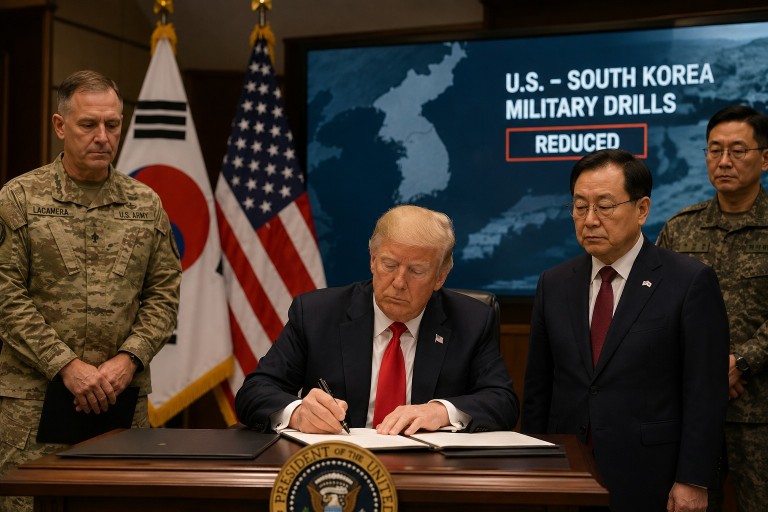
In a move linked to his rapport with North Korean leader Kim Jong-un, U.S. President Donald Trump has mandated a significant decrease in the scale of joint military exercises with South Korea. Trump highlighted the high costs and the message these drills send to North Korea as reasons for his decision. The Ulchi Freedom Shield exercises, set to involve approximately 18,000 South Korean troops alongside U.S. and United Nations Command forces, were scheduled to start on Monday and run through August 27. Although it was too late to call off the drills entirely, Trump directed Defense Secretary Pete Hegseth to reduce U.S. involvement significantly. Despite Trump’s orders, South Korea’s defense ministry confirmed that the exercises would proceed as planned.
This decision emerges amid warnings from U.S. and South Korean military officials about North Korea’s growing battlefield proficiency, attributed to its military collaboration with Russia in the conflict in Ukraine. North Korea has reportedly committed over 14,000 troops to support Russian forces and has supplied artillery ammunition and ballistic missiles. Officials note that North Korean troops are acquiring skills in modern warfare technologies, such as drones, GPS disruption, cyber operations, and missile systems, which could enhance Pyongyang’s military capabilities upon their return.
Historically, Trump has either reduced or suspended major joint military exercises with South Korea while seeking diplomatic engagement with Kim. This recent decision has sparked concerns in Seoul regarding the future of the U.S.-South Korea alliance and the regional deterrence framework. South Korean experts caution that scaling down the exercises may undermine military preparedness and deterrence capabilities, offering minimal diplomatic advantage since North Korea has consistently demanded the complete cancellation of such drills.
North Korea has labeled these exercises as a rehearsal for a potential aggressive war and has threatened to counter with stronger military actions. In anticipation of the drills, Pyongyang has already test-fired ballistic missiles. Despite Trump’s directive, South Korean officials have emphasized the critical role of the joint exercises in countering an increasingly sophisticated North Korean military threat.