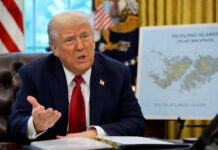
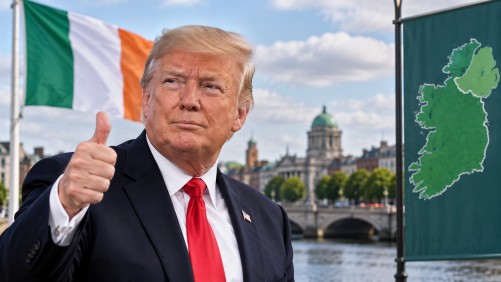
During a visit to Dublin, former US President Donald Trump expressed his support for the unification of Northern Ireland with the Republic of Ireland, stating that he would “love” to see such a development. Trump suggested that this unification could happen eventually and proposed that it “may as well happen now.” While acknowledging that the United Kingdom would have input on the matter, he described the potential unification as “fantastic.”
Trump’s remarks elicited swift reactions from both the UK government and Northern Ireland’s unionist leaders. A representative from Downing Street reiterated the current UK stance, which holds that there is not enough support at present for a referendum on Irish unification as outlined by the Good Friday Agreement. Gavin Robinson, leader of the Democratic Unionist Party, emphasized that any decision on Northern Ireland’s constitutional future should be made by its people, not political figures in London, Dublin, or Washington. He also expressed his continued support for Northern Ireland remaining part of the United Kingdom.
This position from Trump marks a notable shift from previous US administrations, which typically maintained neutrality regarding Northern Ireland’s constitutional matters. Despite this departure in tone, there was no indication that Trump’s remarks signaled any change in official US policy.
Beyond the topic of Irish unification, Trump’s visit included discussions on US-Irish economic relations and other international issues. His presence in Ireland was met with protests, as thousands gathered in Dublin to voice their opposition to his policies and to demand that he leave the country.
Following his engagements in Dublin, Trump traveled to his golf resort in County Clare, where he planned to attend the Irish Open before returning to the United States.