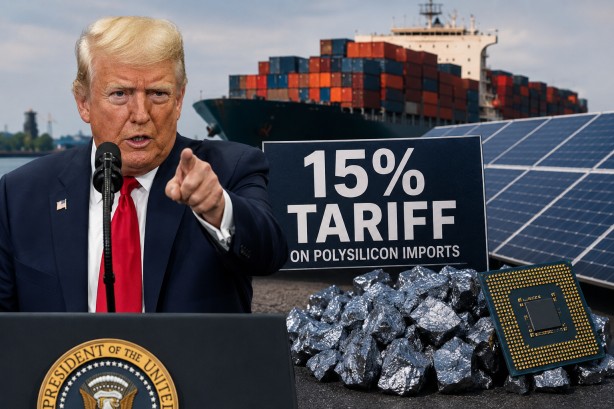
In an effort to bolster domestic production and reduce dependency on China, US President Donald Trump has announced a 15% tariff on imported products made with polysilicon, a key component in semiconductor and solar panel manufacturing. This tariff, effective December 4, aims to strengthen critical supply chains that are vital to the nation’s economic and national security. Polysilicon, an ultra-pure form of silicon, is essential in producing semiconductors for artificial intelligence systems and data centers, as well as solar cells and panels. Currently, China holds the position as the world’s leading producer of this material.
The new tariff measures also introduce specific minimum import prices: $21 per kilogram for polysilicon, $100 per kilogram for polysilicon ingots and wafers, $0.22 per watt for solar cells, and $0.38 per watt for solar modules and panels. This initiative is designed to support the commercial viability of domestic polysilicon production, encouraging investment in local manufacturing facilities and potentially offering incentives for companies that participate.
China has expressed disapproval of the US’s decision, accusing the administration of using national security as a pretext to hinder Chinese businesses and warning of the potential for these protectionist actions to disrupt bilateral trade. Despite these tensions, the US maintains that these tariffs are necessary to reinforce domestic capabilities and safeguard vital industries.
The United States currently houses two major polysilicon production facilities: one operated by Hemlock Semiconductor in Michigan and another by Wacker Chemie in Tennessee. By implementing these tariffs and possible incentives, the US government aims to enhance the competitiveness and sustainability of its domestic polysilicon industry.
This move by the US comes amid China’s robust growth in exports, particularly in sectors such as electronics and artificial intelligence-related products. As China continues to dominate high-value manufacturing, the US’s latest tariff is part of a broader strategy to recalibrate its economic ties and reduce vulnerability in strategic industries.