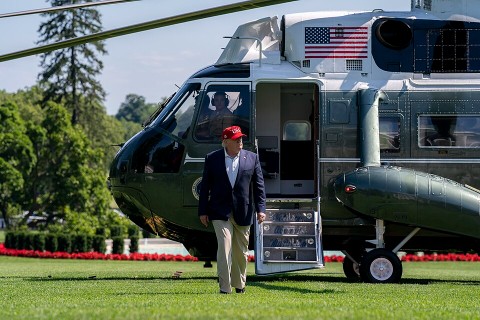
In a move that could strain U.S.-China relations, former President Donald Trump has expressed his intent to speak with Taiwan’s President Lai Ching-te. This unprecedented step for a U.S. leader comes as Trump continues to assert his bold approach to foreign policy. Before boarding Air Force One in Maryland, Trump told reporters, “I’ll speak to him,” referring to Lai, and mentioned addressing “the Taiwan problem.” This would mark a significant break from long-standing U.S. diplomatic practice, which shifted recognition from Taipei to Beijing in 1979. Despite no direct talks since then, Trump previously broke protocol by speaking with then-Taiwan President Tsai Ing-wen during his transition period in 2016, which prompted a complaint from China.
The prospect of a call has stirred responses from Taiwan’s foreign ministry, with President Lai reportedly open to the dialogue. However, no formal arrangements have been made for such a conversation. Trump’s recent remarks were his second on the matter in a week, following a meeting with Chinese President Xi Jinping, suggesting a deliberate rather than accidental intention. The White House has not commented on the possibility or timing of the call, nor has China’s embassy in Washington offered an immediate response. While Trump has approved more arms sales to Taiwan than any previous president, he has also described these sales as valuable negotiating tools.
Taiwan remains a critical strategic partner for the U.S., being its fourth-largest trading partner. The island’s trade is dominated by the export of advanced semiconductors, which are crucial to the global economy. The U.S. is legally obliged to support Taiwan’s defense, a stance backed by both Republican and Democratic lawmakers urging the continuation of weapons sales to the island. Meanwhile, Beijing has expressed its displeasure by delaying approval for a visit by a senior Pentagon official, contingent on Trump’s decision regarding a $14 billion weapons sale to Taiwan. This highlights the diplomatic tightrope the U.S. must walk in balancing relations with China and support for Taiwan.
President Lai emphasized Taiwan’s commitment to maintaining peace across the Taiwan Strait, countering Beijing’s military expansion in the Indo-Pacific. He stated that Taiwan’s pursuit of democracy and freedom should not be viewed as provocative, a sentiment that echoes the island’s long-standing stance against Chinese aggression. Lai’s comments underscore the island’s desire to preserve its democratic way of life amid growing Chinese pressures. The potential call with Trump, while welcomed by Taiwan, remains a sensitive issue, as it could disrupt the already fragile U.S.-China relations further.
Trump’s interactions with China and Taiwan have consistently been a point of contention, with his language often sending mixed signals. While he has described his relationship with Xi as “amazing,” his actions, including the potential Taiwan call, suggest a more complex diplomatic landscape. This balancing act is further complicated by China’s view of Lai as a separatist, which adds another layer to the already complex geopolitical dynamics. The unfolding situation continues to be closely watched as it could have significant implications for international relations in the region.